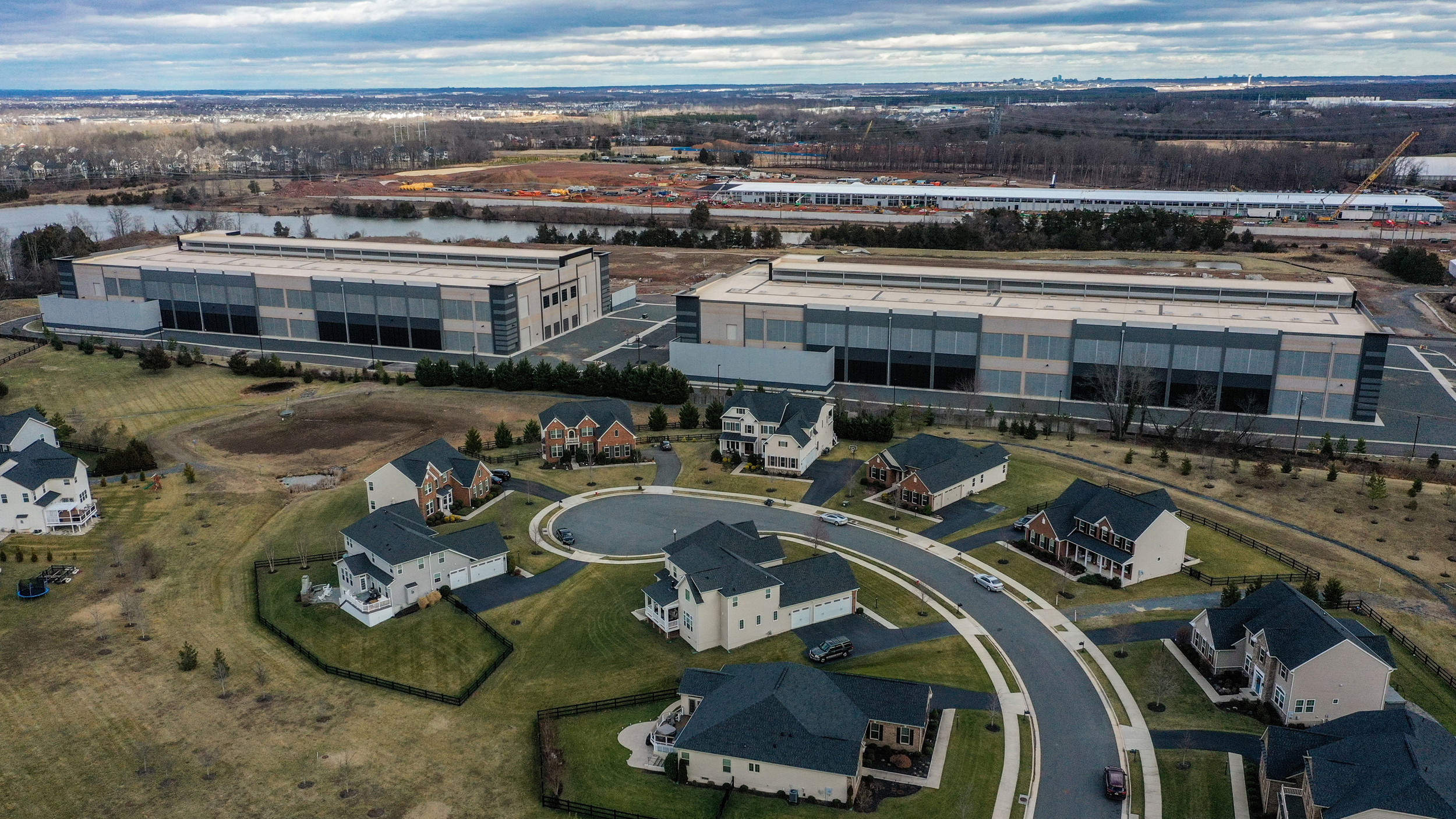
Amazon data centers loom over houses at the edge of a neighborhood in Loudoun County, Va. Credit: Jahi Chikwendiu/The Washington Post via Getty Images
ASHBURN, Va.—Driving up the six-lane Route 28 in Loudoun County, Virginia, there’s a dark blue one on the left. Further up the way in a small clearing of trees, there’s a gray one on the right. Across the landscape, metal cables criss-cross in every direction to connect power to the sprawling buildings.
They’re not big-box stores like Ikea or Target. They’re bigger. They’re data centers that house the computers processing the internet and artificial intelligence. And they’re all over these suburban counties outside of Washington, D.C.
Virginia, especially Northern Virginia, leads the world in development, far outpacing other top markets such as Beijing.
So how did it happen that this region came to dominate data centers, an industry whose growth now fuels debates about electricity bills, climate change and the role of technology in our lives? The answer is a combination of government support, the presence of infrastructure used by internet pioneers such as America Online, cheap electricity and the availability of land.
“There was all that land next to Dulles airport that was unused, and so it was cheap, available and large enough, and getting a major internet connection was easy,” said Shane Greenstein, a professor at Harvard Business School who has written about the economic geography of data centers.
Considering those factors, it’s “really not a surprise” that Virginia took the lead and maintained it, he said.