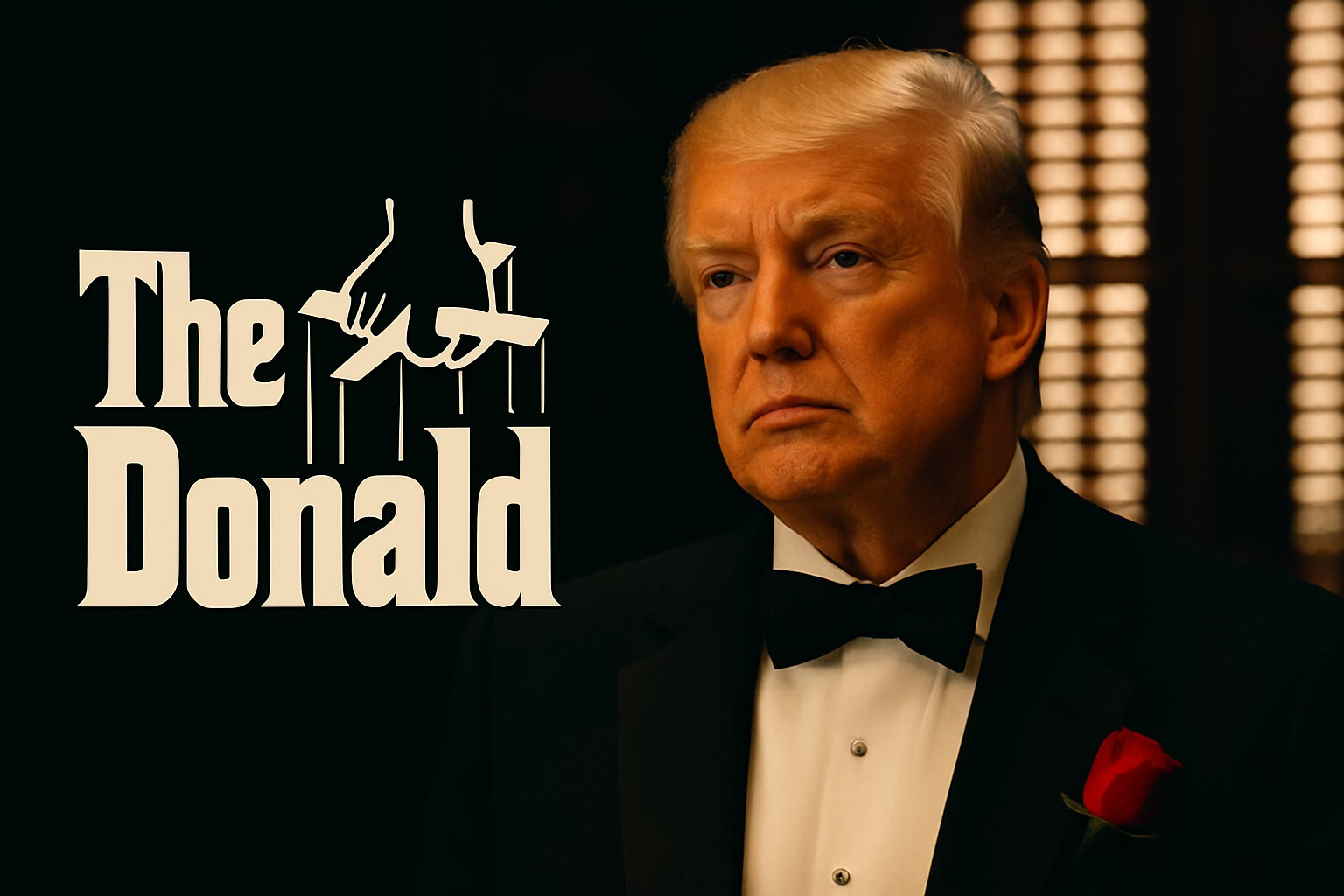
Dictator or mob boss? President Trump seems to be leaning into “dictator,” but I’d argue that Al Capone and John Gotti fit better than Adolf Hitler and Benito Mussolini. Of course, Trump could squeeze into their brown and black shirts, too, or at least Herman Goering’s.
On Monday, Trump told reporters, “A lot of people are saying maybe we like a dictator.” And on Tuesday, in that endless Cabinet suck-up show, he doubled down on the d-word: “The line is that I’m a dictator, but I stop crime…So a lot of people say, ‘You know, if that’s the case, I’d rather have a dictator.’”
Twice, Trump used his patented, “A lot of people say….” This is his way of signaling that the public supports him as he prepares to do something awful. And sometimes it does. During the 2024 campaign, he said he wanted to be a dictator just on “Day One,” which millions of gullible voters bought. Now, “a lot of people are saying” he can be a dictator for all 1,460 days of his presidency because crime hasn’t come down enough. Will that one fly, too?
I don’t think so. Trump is a talented bully, with mad skills at sensing weakness, whether the target of his intimidation is a political party or a person who has dared to cross him. And if Americans have to choose between a firm hand and crime, they choose the firm hand. Crime is only down if it feels that way where you live.
But if the choice is between a true dictator and maybe, possibly reducing crime a bit, and it’s all argued about in an obviously political context? Then the calculation that Trump says the public is making may come out in a different place. Trump is historically ignorant and doesn’t get that the word “dictator” has had a pejorative connotation in the public mind since before World War II.
Americans didn’t sign up for a police state. Voters wanted a secure border but weren’t expecting masked agents to be spread-eagling brown-skinned shoppers at Home Depot. Trump’s numbers on immigration are way down. Now it appears that the same thing is happening with crime. A Reuters/Ipsos poll shows only 38 percent support for sending the National Guard into Washington, D.C., which is almost exactly where Trump’s anemic approval ratings stand.
Trump has convinced himself that he’ll be greeted with hosannas on the South Side of Chicago. But there’s no sign amid $800 million in cuts to successful crime prevention programs that “African-American ladies, beautiful ladies, are saying, ‘Please President Trump, come to Chicago, please,’” as Trump implausibly claimed last week.
“Do not come to Chicago,” Illinois Gov. J.B. Pritzker warned in an impressively defiant speech.
If Trump does send in troops, he shouldn’t expect anything good to come of it for him, as the deployments this summer to Washington and Los Angeles suggest. National Guard forces, by law, must leave Washington, D.C. by September 6, and they will likely do so with little to show for their presence beyond picking up some trash. The 60-day occupation of Los Angeles ended with a whimper in July.
Trump may be hoping for a 1968-style confrontation to exploit in Chicago, but he won’t likely get his wish. Pritzker, who is popular on this issue, has told the public — unified and disciplined in its resistance to military occupation — that any Guardsmen who do appear from other states are just doing their jobs and could be court-martialed for disobeying orders. So they should not be harassed.
Can this refusal to be baited by Trump hold not just in Chicago but in other cities in blue states (no red ones, of course, with much higher crime rates) where even one incident could lead Trump to invoke the Insurrection Act? Not clear, but the future of the republic could turn on the answer.
In the Cabinet Room, Trump boiled down his view of the Constitution he took an oath to uphold:
“I have the right to do anything I want to do. I’m the president of the United States. If I think our country is in danger, and it is in danger in these cities, I can do it.”
Having just said he has the power of a king, Trump then tried to take a little of the dick out of dictator: “But it would be nice if they called and said, ‘Would you do it.’”
This latter line sounds as if he’s just responding to the people he is serving. But it’s really the kind of “nice” talk that often precedes a gangland-style execution.
We know that Don Vito Trump learned his knee-capping at Roy Cohn’s knee. Cohn often represented mafia clients (Tony Salerno, Carmine Galante, John Gotti), and he passed on some of their charming customs to his protege, who also no doubt learned from The Godfather, the quintessential movie for men of his vintage.
And of course, Trump, like his father, used intermediaries for business relationships (often involving concrete and other building materials) with mobsters in New York and Atlantic City, as I’ve explained.
Trump’s demand for loyalty and vig for his family are familiar from the underworld, but so is his model for running the government. Consider what mob bosses actually do all day. Whacking people is a small part of the job. Mostly, they run rackets. That’s why the use of the Racketeer Influenced and Corrupt Organizations (RICO) Act of 1970 has crippled organized crime.